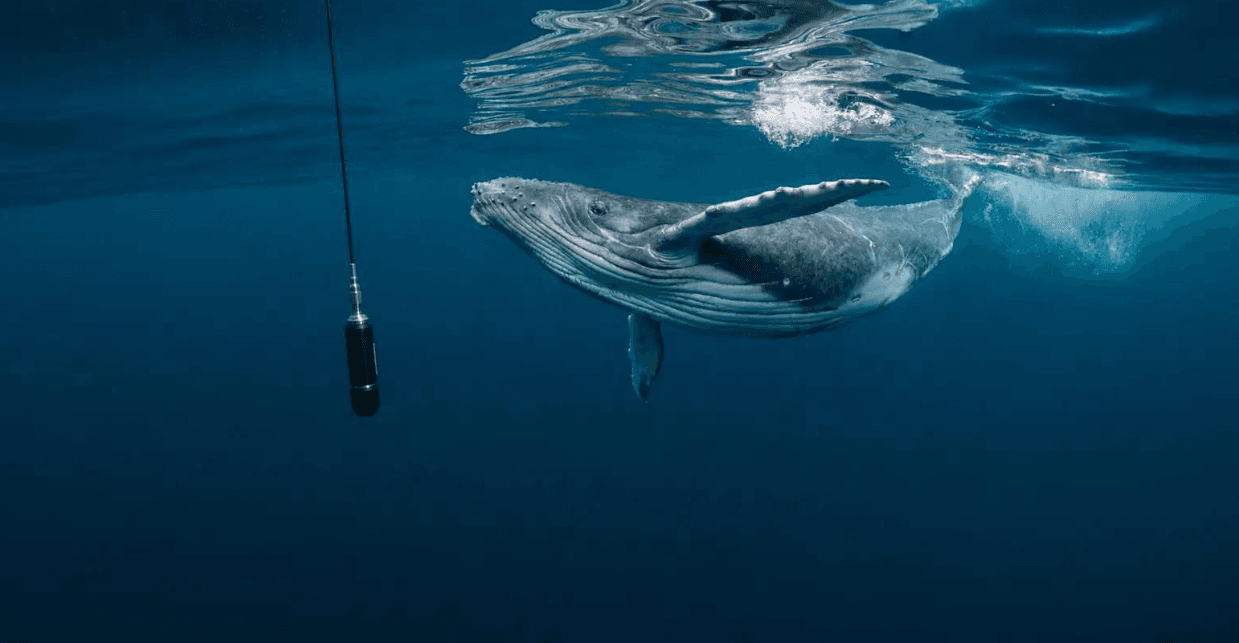
How Do Scientists Detect New or Unusual Sounds in Humpback Whale Songs?
Humpback whales produce a wide variety of underwater sounds, including the organized sequences known as songs. Researchers study these vocalizations to understand how whales communicate, how acoustic patterns vary, and how singing behavior changes over time.
Sometimes an underwater recording contains a sound that does not fit the patterns researchers have already classified. It may be an unfamiliar vocalization, an unusual variation of a known sound, a call from another marine animal, or simply noise introduced by the environment or recording equipment.
Determining which explanation is most likely requires careful investigation. Scientists use hydrophones, audio analysis software, spectrograms, and systematic verification procedures to identify unusual humpback whale sounds without assuming that every unfamiliar sound represents a discovery.
For those interested in Samaná whale watching in the Dominican Republic, this process reveals how acoustic research can uncover details about whale behavior that cannot be observed through surface sightings alone.
What Makes a Humpback Whale Sound Unusual?
A sound may be considered unusual when it differs noticeably from the acoustic patterns documented in a particular recording collection or classification system.
The difference might involve its frequency, duration, rhythm, tonal structure, pulse pattern, or relationship to surrounding sounds.
For example, researchers might encounter a sound with a frequency contour that does not match any previously labeled unit in their dataset. Another recording might contain an unexpected series of pulses or a sound that appears in a different context from familiar patterns.
However, unusual does not automatically mean new to science. A sound may be uncommon in one dataset but well documented elsewhere. It might also be a known vocalization recorded under different conditions.
Scientists therefore distinguish between an unfamiliar observation, a previously unclassified acoustic event, and a genuinely novel finding supported by broader evidence.
1. Collecting Underwater Sound Recordings
The first step is obtaining suitable recordings.
Scientists often use hydrophones, which are underwater microphones designed to detect acoustic signals. Depending on the study, hydrophones may be deployed from research vessels, attached to underwater monitoring systems, or used in other appropriate recording arrangements.
Researchers select equipment and recording settings based on the frequencies they want to study and the conditions in which the recordings will be collected.
They may document:
- Recording date and time.
- Location and deployment conditions.
- Hydrophone characteristics.
- Sampling rate and recording duration.
- Background noise and environmental conditions.
- Any available observations of whales or other sound sources.
These details help researchers interpret an unusual event. A sound recorded near a vessel, for instance, may require additional checks for engine noise or mechanical interference.
A recording alone does not always establish which animal produced a sound. Linking a vocalization to a particular whale generally requires additional evidence.
2. Finding Unusual Events in Long Recordings
Underwater acoustic recordings can contain hours of sound, making it difficult to inspect every second manually.
Researchers may begin by reviewing recordings visually and listening to selected segments. They can also use software to identify candidate events based on signal intensity, frequency characteristics, or other measurable features.
An automated detector might flag a short sound that differs from the surrounding background. The event then becomes a candidate for further analysis rather than an immediate scientific discovery.
Detection methods must be designed carefully. A detector trained to recognize familiar vocalizations may miss unusual sounds, while a broad detector may flag waves, vessel noise, or unrelated marine animal calls.
Researchers therefore balance the need to find uncommon events against the risk of generating too many false alarms.
3. Examining Spectrograms for Unexpected Patterns
A spectrogram displays how the frequency content of a sound changes over time. It is one of the main tools used to inspect whale vocalizations.
Researchers can look for features such as:
- Unfamiliar rising or falling frequency contours.
- Unexpected tonal components.
- Unusual pulse sequences.
- Distinctive changes in sound duration.
- Acoustic patterns that differ from nearby events.
- Multiple overlapping signals.
Suppose a recording contains a brief tonal sound that rises in frequency and then abruptly changes into a pulsed pattern. Researchers may inspect the spectrogram to determine whether the event contains one continuous signal or several overlapping sounds.
They can then listen to the original recording and compare it with similar events.
Spectrogram appearance depends partly on analysis settings, including window size and frequency resolution. Researchers should check whether an apparent anomaly remains meaningful under appropriate analysis settings rather than treating a visual difference as definitive proof.
4. Checking Whether the Sound Is Genuine
Before classifying an unfamiliar sound as a whale vocalization, scientists investigate alternative explanations.
Could it be recording noise?
Electrical interference, equipment handling, and other technical problems can create sounds that resemble biological signals. Researchers inspect the recording for clipping, abrupt changes in signal level, and other signs of equipment-related artifacts.
Could it come from a vessel?
Boat engines and other mechanical sources may produce tonal or pulsed sounds. Researchers consider the vessel's proximity, available operational information, and the acoustic characteristics of the event.
Could another marine animal have produced it?
The ocean contains vocalizing marine mammals and many other biological sound sources. An unfamiliar event should not automatically be attributed to a humpback whale simply because whales are present in the area.
Could it be a known sound recorded under different conditions?
Distance, background noise, underwater propagation, and recording equipment can change how a familiar vocalization appears in a recording. Researchers compare the event with established examples before concluding that it represents a distinct pattern.
When evidence is insufficient, classifying the event as an unidentified acoustic signal may be more accurate than assigning it a specific source.
5. Comparing the Sound With Existing Reference Recordings
Once an event has been identified as a candidate biological sound, researchers can compare it with previously documented vocalizations.
They may examine frequency range, duration, pitch contour, pulse structure, rhythm, and other acoustic features.
Comparison can involve recordings from the same study, earlier observations, or suitable reference datasets from other locations. The quality and comparability of those references matter.
Researchers should also distinguish between a sound that is acoustically unusual and one that represents a genuinely new vocal category. An unfamiliar example may fall within the natural variation of an existing category when more recordings become available.
A systematic reference library helps scientists make these judgments more consistently.
6. Using Computer Algorithms to Flag Unfamiliar Sounds
Computer-assisted acoustic analysis can help researchers search large recordings for events that differ from familiar patterns.
Some systems identify sound events using predefined rules. Others use machine-learning models to classify known vocalizations or group sounds according to acoustic similarity.
Researchers may use anomaly-detection methods to identify events that appear unusual relative to a reference dataset.
For example, an algorithm could assign a low similarity score to a sound that differs from the examples it has previously analyzed. That result indicates that the event deserves closer inspection; it does not establish that the sound is new, biological, or produced by a humpback whale.
Automated systems have limitations. If their training data do not represent the full range of natural vocal variation, ordinary whale sounds may be flagged as anomalies. Conversely, a genuinely unusual sound may be missed if it resembles a familiar category in the features the model uses.
Human review and independent validation remain important.
7. Determining Whether the Sound Represents a New Pattern
After checking for artifacts and comparing the event with reference recordings, scientists evaluate whether the sound warrants a new classification.
They may ask:
- Does the sound differ consistently from established categories?
- Is the recording clear enough to support reliable measurements?
- Can the event be distinguished from other biological or mechanical sources?
- Does the same pattern occur more than once?
- Do independent reviewers agree with the classification?
- Is there enough evidence to describe the event accurately?
Repeated observations can strengthen a conclusion, but a single well-recorded event may still be scientifically valuable if it is clearly documented.
Researchers should describe the limits of the evidence. An unusual vocalization observed once is not necessarily a new song type, a new communication signal, or evidence of a change in the whale population.
8. Why Repeated Recordings Matter
A single unusual sound offers limited information about how common the event is or whether it forms part of a larger pattern.
Repeated recordings can help researchers determine whether an event is isolated or recurring. They may investigate whether it appears at similar times, occurs in the same acoustic sequence, or is associated with particular observed behaviors.
Longer monitoring periods can also reveal whether a pattern occurs under different environmental conditions.
However, repeated sounds should not automatically be treated as independent observations. If the same event is captured multiple times during one recording session, the samples may reflect a single underlying episode.
Researchers must account for the sampling design when drawing conclusions about frequency or prevalence.
9. Can an Unusual Sound Reveal Changes in Whale Song?
An unfamiliar sound may prompt researchers to investigate whether an established song pattern has changed.
They might compare recordings from different dates or breeding seasons, examining whether a new unit appears, a familiar pattern becomes less common, or a previously observed sequence changes.
But several explanations are possible. The apparent novelty could result from incomplete earlier recordings, differences in recording quality, changes in which whales were detected, or a classification system that has become more detailed.
Researchers need comparable datasets and consistent analysis methods to distinguish these explanations.
Even when a vocal pattern has genuinely changed, acoustic evidence alone may not explain why it changed. Further research is needed to investigate possible roles of vocal learning, social interactions, and environmental influences.
10. How Researchers Document Unusual Vocalizations
Clear documentation allows other researchers to assess and potentially reproduce the analysis.
A useful record may include the original audio segment, its timestamp, spectrogram, measurement settings, classification notes, and any relevant information about recording conditions.
Researchers may also document alternative explanations considered during verification and explain why they accepted or rejected a proposed classification.
Where appropriate, recordings or derived data can be shared through scientific repositories, subject to ethical, legal, and project-specific restrictions.
Transparent documentation helps prevent an interesting acoustic observation from being overstated and gives future researchers a basis for comparison.
What Could This Research Reveal About Samaná Bay?
Samaná Bay in the Dominican Republic is known as a seasonal destination for humpback whale watching. Visual observations can help researchers study surfacing, movement, and interactions, while underwater acoustic recordings offer a different source of information.
Researchers could apply unusual-sound detection methods to suitable local recordings to investigate whether particular acoustic events occur in the area. They would need to verify each candidate signal, consider alternative sound sources, and compare findings with appropriate reference material.
Boat activity and other background sounds may complicate this work, making careful recording procedures especially important.
No particular unusual vocalization should be attributed to Samaná Bay without supporting local evidence. The methods described here explain how such a finding could be investigated, not a claim that a specific discovery has already been made there.
For visitors, the scientific value of whale watching extends beyond what can be seen from a boat. Acoustic research can help build a more detailed picture of the underwater environment that these animals inhabit.
Common Mistakes When Interpreting Unusual Whale Sounds
Several errors can lead to misleading conclusions.
Calling every unfamiliar sound a new discovery: An event may be known elsewhere or fall within normal variation.
Ignoring equipment artifacts: Technical interference can resemble biological signals.
Assuming the source from location alone: The presence of humpback whales does not prove that they produced every recorded sound.
Relying only on a spectrogram: Visual patterns need to be considered alongside audio, recording conditions, and other evidence.
Treating automated alerts as proof: Algorithms identify candidates that require validation.
Making claims from limited recordings: A small dataset may not represent the full range of whale vocal behavior.
Avoiding these mistakes makes acoustic research more reliable and helps readers understand what the evidence actually supports.
Frequently Asked Questions
What is an unusual humpback whale sound?
It is an acoustic event that differs from patterns documented in a particular reference dataset. It may be a variation of a known vocalization, an unclassified biological sound, another animal's sound, or a recording artifact.
How do scientists detect unfamiliar whale vocalizations?
They use underwater recordings, spectrogram inspection, audio analysis, and sometimes automated detection algorithms to locate candidate events for further investigation.
Can a computer discover a new whale song?
Computer algorithms can flag unfamiliar patterns, but researchers must verify the source and compare the event with existing data before claiming a new vocal category or song pattern.
Does an unusual sound mean a whale is communicating a new message?
Not necessarily. The acoustic pattern may be unfamiliar, but its meaning and biological function cannot be inferred from novelty alone.
Why are hydrophones important for whale research?
Hydrophones capture underwater sounds that are difficult or impossible to assess through surface observations alone. They allow scientists to study vocalizations and the acoustic environment.
Could scientists detect unusual whale sounds in Samaná Bay?
Potentially, if suitable recordings are collected and analyzed systematically. Any conclusion about sounds recorded locally must be supported by the actual acoustic data.
Conclusion
Detecting unusual humpback whale sounds requires more than noticing an unexpected noise. Scientists locate candidate events, inspect their acoustic features, rule out technical and environmental explanations, and compare them with documented vocalizations.
Hydrophones, spectrograms, computer-assisted analysis, and independent review can make this process more systematic. Even then, researchers must distinguish an unfamiliar observation from a verified new vocal pattern and avoid assigning meaning without supporting evidence.
For those interested in Samaná whale watching, this research demonstrates how acoustic monitoring can complement observations at the surface. Careful investigation of unusual sounds may help scientists expand their understanding of humpback whale vocal behavior while maintaining a clear distinction between evidence and speculation.

Local explorer & expert guide in Taxi Sabana de la Mar.